Most Rocket League players have run into that confusing pop-up at least once: you invite a friend to queue ranked 2v2, and the game tells you you’re not eligible to play together, no further explanation. If you’ve ever stared at that message wondering what you did wrong, what is rank disparity in Rocket League is the first question you need answered. This little-known rule shapes almost all party play in competitive lobbies, and misunderstanding it can lead to temporary queue blocks, or even ranked bans if you repeatedly try to work around it. We’re breaking down everything you need to know to play with friends fairly and avoid unnecessary penalties.
What Is Rank Disparity in Rocket League, Exactly?
Rank disparity is a matchmaking rule implemented by Psyonix that limits how far apart the ranks of players in a single ranked party can be. The core goal is to stop unbalanced teams from ruining the competitive experience for random players in public lobbies. The allowed rank gap changes based on the skill bracket of the highest-ranked player in your party, so the rules for lower-ranked players are more flexible than those for top-tier competitors.
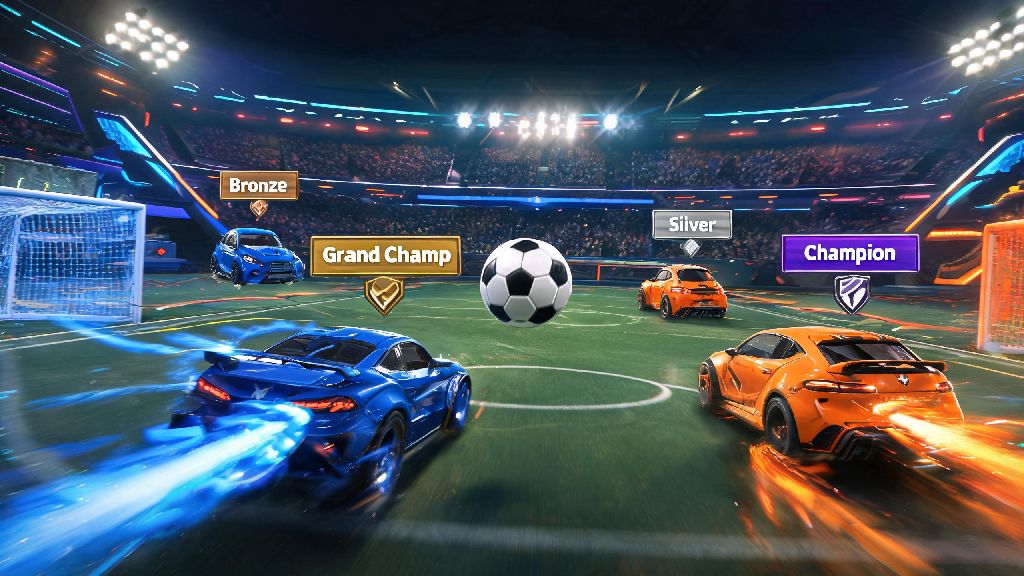
Rank disparity only applies to ranked standard, 2v2, and 1v1 playlists – it does not impact casual queues, extra modes, or private matches. For Bronze, Silver, and Gold players, you can queue with any friend within 3 full ranks of your highest party member. For Platinum, Diamond, and Champion players, that gap shrinks to 2 ranks. For Grand Champion and Supersonic Legend players, you can only queue with other players within 1 rank of your highest party member to compete in ranked.
The rule uses your hidden MMR, not just your displayed rank badge to calculate eligibility, so you might run into blocks even if your visible ranks appear to fall within the allowed gap. That’s because your displayed rank often lags a little behind your actual skill rating, especially if you’re on a hot win streak or just returned to the game after a long break. It’s not a glitch, it’s just the system using the most accurate skill data available to keep matches fair.
Why Did Psyonix Add Rank Disparity to Competitive Play?
Before rank disparity rolled out across all ranked playlists in 2022, unbalanced party queues were one of the biggest complaints in the Rocket League community. Top-tier players would regularly create smurf accounts, or queue with low-ranked friends on new accounts, to get matched against much lower-skilled lobbies. These matches would almost always end in blowouts, with the smurf team winning 8-0 or 9-1 in just a few minutes, and there was almost nothing the opposing team could do to compete.
Boosting was also rampant before the rule was implemented. Players would pay higher-ranked competitors to either log into their account and rank them up, or queue with them to carry them to ranks they could never reach on their own. These boosted players would then end up in lobbies far above their actual skill level, ruining matches for their random teammates who were forced to play with someone who couldn’t keep up. Rank disparity has cut reported smurfing and boosting incidents in party queues by nearly 60% since its full rollout, according to data shared by Psyonix in 2024 community updates.
Of course, the rule isn’t perfect. A lot of long-time players who have friends new to the game complain that it makes it hard to play ranked together, which is a valid frustration. But the tradeoff for far fewer unbalanced, unfun matches for the broader community has been overwhelmingly positive for most players. I’ve played ranked Rocket League since 2019, and I can count on one hand the number of smurf blowout matches I’ve had in the last two years, compared to at least one a week before the rule launched.
Common Rank Disparity Issues and How to Fix Them
Even if you’re not trying to break the rules, you might run into rank disparity-related issues from time to time. Most of these are easy to fix once you understand what’s causing the problem, but a few require more patience. Here are the most common issues players face:
If you keep running into blocks and you’re sure your ranks and MMR are within the allowed gap, try restarting your game. Very rarely, a bug will cause the system to pull outdated rank data for you or your friend, and a quick restart will fix that issue almost every time. Never try to create a new account to get around rank disparity limits – that counts as smurfing, and can lead to a permanent ban on all of your accounts if Psyonix detects what you’re doing.
How to Play With Friends Outside Your Rank Gap Fairly
Rank disparity doesn’t mean you can’t play with friends who are at very different skill levels – it just means you can’t play standard ranked playlists together. There are tons of fun, low-pressure ways to play with your friends without breaking the rules or ruining matches for other players, and many of them are just as fun as competitive ranked queues.
Casual standard, 2v2, and 3v3 playlists have no rank disparity limits at all, so you can queue with any friend no matter how far apart your ranks are. Casual matches still use MMR to match you against teams of similar average skill, so you won’t get matched against total newbies if you’re a high-ranked player playing with a low-ranked friend. I regularly queue casual 2v2 with my friend who’s a Supersonic Legend, and even though I’m only Diamond 2, we get matched against other Diamond and Champion teams that are a perfect middle ground for our skill levels. It’s still competitive, but there’s no pressure of rank loss if we lose.
Ranked extra modes like Hoops, Rumble, Dropshot, and Snow Day also have no rank disparity rules, so you can play those competitively even if you’re 5 ranks apart in standard play. Most players don’t take extra mode ranks as seriously as standard ranks, so it’s a great way to scratch that competitive itch without running into queue blocks. Private matches are another great option, especially if you have a group of 4 or 6 friends who want to play against each other. You can adjust all the match settings, add bots to fill out empty spots, and even run your own little tournament with no restrictions at all.
If you really want to play standard ranked with a friend who’s far below your level, the best approach is to help them rank up first. Play casual matches with them to practice mechanics, give them small tips to improve their positioning, and let them play solo queues to build their skill and rank up until they’re within the allowed gap. It’s more fun for both of you, and you won’t have to worry about running into penalties for breaking the rules.
At the end of the day, rank disparity rules exist to make Rocket League’s competitive play as fair as possible for everyone who queued up to play a balanced, fun match. It’s not a perfect system, but it’s fixed most of the worst issues that plagued ranked play for years. Now that you know what is rank disparity in Rocket League, you can avoid common penalties, play with friends fairly, and spend less time staring at confusing error messages and more time scoring aerials and winning matches.