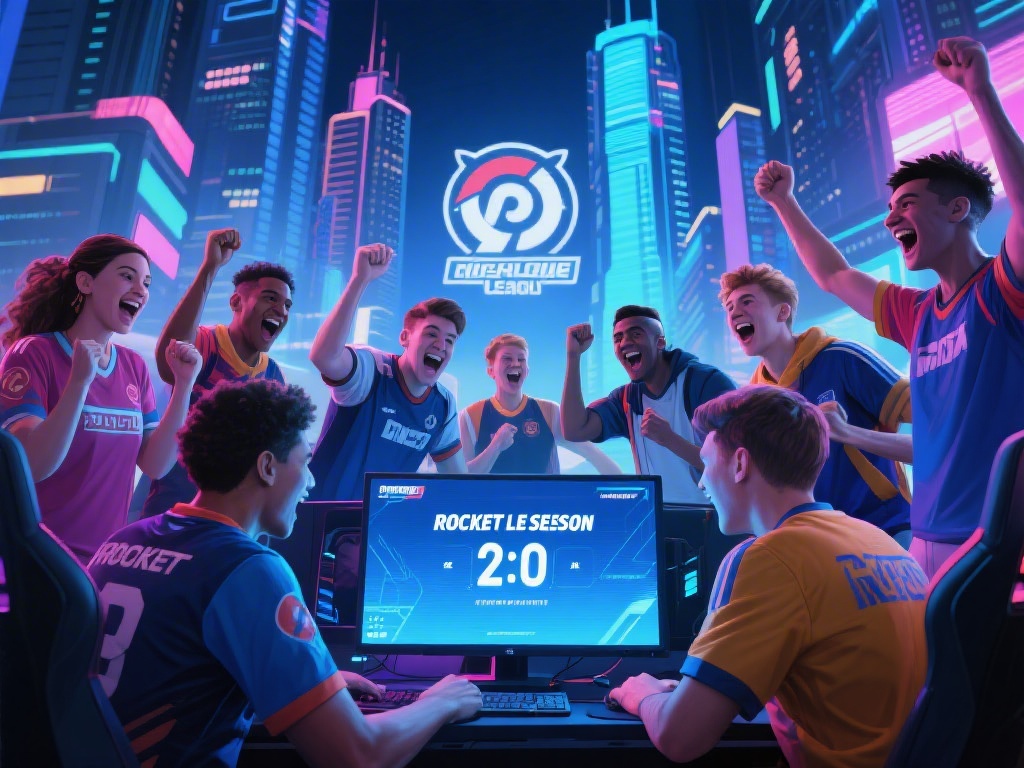
Eleven years. That’s how long Rocket League has been running on the same engine—Unreal Engine 3, a piece of technology that was already showing its age when the game first launched back in 2015. But at the RLCS Paris Major on May 24, 2026, Psyonix and Epic Games finally did what players have been waiting for: they announced that Rocket League will skip Unreal Engine 4 and 5 entirely and jump straight to Unreal Engine 6 [8†L5-L11][13†L6-L9]. The teaser trailer, unveiled during the semifinals, showed off shinier car models, upgraded lighting, cinematic camera angles, and a stadium that looked sharper than ever—improvements to the crowd, the lights, and even the grass [8†L14-L18][13†L15-L23].
The response from the arena was electric. An announcer took the stage and declared, “To all of our friends here in Paris and those watching all around the world, this is the future” [8†L11-L14][13†L13-L14]. As the trailer wrapped and the Unreal Engine 6 logo appeared, fans knew they were witnessing the start of a new era. Karmine Corp, by the way, took the tournament title that same day, beating Twisted Minds in the grand finals [10†L4-L6].
But even the most dedicated Rocket League player needs a break from the grind of aerials, rotations, and last-second overtime saves. For those moments when you want to step away from the intensity of competitive ranked and focus on something more methodical and low-stakes, a completely different kind of challenge awaits: Rummy77. Unlike Rocket League’s split-second reactions and mechanical precision, Rummy77 rewards patience, observation, and the discipline to know when to hold onto a card and when to let it go—a perfect companion for players who love strategy in all its forms.
This guide covers everything you need to know about Rocket League in 2026—the massive Unreal Engine 6 upgrade, Season 22’s new content, the Cash Cup circuit, the RLCS 2026 season and 2v2 World Championship, 2v2 rules and competitive meta, player count trends, and more—and then explores why Rummy77 is such a compelling alternative when you need to reset.
Chapter 1: Unreal Engine 6 — Rocket League’s Biggest Technical Leap in 11 Years
If there’s one announcement that truly reshaped what players expect from Rocket League’s future, it’s the move to Unreal Engine 6. The decision to skip two entire generations of engine technology is bold, and it signals that Psyonix is thinking long-term—future-proofing the game for the next decade [14†L37-L41].
1.1 What the Teaser Showed
The first-look trailer, which ran just over a minute, was light on hard details but heavy on visual impact. It showed Rocket League running in real-time on Unreal Engine 6, with dynamic lighting, highly reflective surfaces, and intricate detailing on both the cars and the pitch [9†L9-L15]. The stadium in the teaser offered the clearest glimpse of what’s coming: the crowd looked more realistic, the grass had more texture, and the overall presentation felt genuinely next-gen [8†L14-L18][13†L18-L23].
Toward the end of the trailer, a wave of colourful cars with custom paint jobs sped across the screen before the Unreal Engine 6 logo appeared for the first time [8†L17-L18][13†L15-L18]. While the teaser didn’t show full gameplay, it confirmed that Rocket League is finally getting the engine upgrade players have been asking for.
1.2 Why Skip UE4 and UE5?
Rocket League originally launched in July 2015 using Unreal Engine 3, a decision that made sense at the time but has become increasingly restrictive as the game has evolved [9†L15-L17]. For years, players have speculated about a possible engine upgrade, but Psyonix remained silent. The decision to skip UE4 and UE5 in favour of UE6 suggests that the team is looking far ahead—building a foundation that can support the game for another decade [10†L17-L20].
That said, the upgrade won’t come quickly. Epic Games CEO Tim Sweeney mentioned in a 2025 interview that UE6 previews might be two to three years away, and industry observers expect a similar timeline for Rocket League’s transition [9†L21-L26][10†L19-L22]. This isn’t a patch; it’s practically a new version of the game, and expectations should be set accordingly [14†L44-L46].
1.3 Community Excitement (and Concerns)
Pro players and content creators who were on the ground in Paris shared their reactions with IGN. Musty said, “As long as the game feels the same, I’m excited. I think it’s going to be the Rocket League we know and love but upgraded” [13†L26-L31]. JamaicanCoconut saw the announcement as proof that the developers care: “You see that they’re developing an entirely new engine just for Rocket League. That’s a level of care that a lot of people didn’t believe in” [13†L31-L39].
However, not everyone is celebrating. Some players pointed out elements in the trailer that looked similar to Fortnite’s UI and ecosystem, raising concerns about tighter integration between the two games [14†L26-L30]. Since both titles are owned by Epic Games, and crossovers already exist, the worry isn’t entirely unfounded. But for now, nothing has been officially confirmed regarding deeper integration—just the promise of a prettier, more stable, more capable Rocket League [14†L31-L36].
Chapter 2: Season 22 — The Current Live Game
While the Unreal Engine 6 upgrade is stealing headlines, Rocket League’s live game is currently in Season 22, which launched on March 11, 2026, and is running alongside the competitive season [11†L36-L39][12†L34-L36].
2.1 New Content in Season 22
Season 22 introduced a fresh Rocket Pass, new training options, and UI elements designed to help players play more strategically. Matchmaking rating recharge timers are now visible, giving players better feedback on their ranked progress [12†L39-L42].
2.2 Limited-Time Discord Quest — Aero Splash Pack
In March 2026, Rocket League launched a limited-time Discord Quest that rewarded players with a free cosmetic bundle called the Aero Splash Pack. The promotion worked on both PC and console, making it one of the more accessible freebies in recent memory [4†L30-L34]. For players who missed it, keep an eye on Rocket League’s official social channels—Discord Quests have become a recurring way to earn exclusive items without spending a dime.
2.3 Player Count Trends — A Healthy Community
Rocket League’s player base remains strong heading into the second half of 2026. Steam charts for May 2026 show an average of 17,758 concurrent players, with a monthly peak of 30,866 [18†L26-L29]. February 2026 saw the highest peak of the year so far at 40,823 [18†L28-L30]. While these numbers don’t account for players on PlayStation, Xbox, Nintendo Switch, or the Epic Games Store—where the majority of the player base now resides following the game’s delisting from Steam—they still reflect a healthy, engaged community [17†L3-L6][10†L28-L31]. As one player put it in a Steam review, “A game that still holds up extremely well to this day” [18†L19-L20].
For context, the all-time Steam peak of 44,016 was achieved back in September 2023, but given that new players can no longer install the game through Steam, the current numbers are remarkably stable [18†L21-L22].
Chapter 3: RLCS 2026 — The Competitive Calendar
The Rocket League Championship Series has been running since late 2025, and 2026 is the fifteenth season of competitive Rocket League. This season introduced two major new features: the inaugural Kick-Off Weekend and the official integration of 2v2 as a competitive mode, bringing the league to three competitive formats alongside 1v1 and 3v3 [15†L9-L17][3†L19-L23].
3.1 RLCS 2026 Season Structure
The season is structured across two splits, each featuring three regional opens leading into an international major. The World Championship, which concludes the season, brings together the best-performing teams from these events plus the winners of the Last Chance Qualifiers [15†L17-L19].
The Paris Major (May 20–24, 2026) was the season’s second major, following the Kick-Off Weekend held earlier in Copenhagen [3†L14-L16][3†L27-L29]. The event drew almost 25,000 fans to the arena [5†L38-L39]. By all accounts, it was one of the most exciting LANs in recent memory—and the perfect stage for the Unreal Engine 6 reveal.
3.2 2v2 World Championship — $170,000 on the Line
The 2v2 World Championship is the season’s headline event for the new mode, scheduled for September 15–20, 2026, with a total prize pool of **170,000∗∗[15†L5−L6].Thetopteamwilltakehome170,000∗∗[15†L5−L6].Thetopteamwilltakehome100,000, second place earns 50,000,andthirdandfourthplacesplit50,000,andthirdandfourthplacesplit10,000 [15†L23-L24].
Only four teams will qualify for this championship, making it an exclusive, high-stakes competition where every match matters [15†L24-L25]. Qualification runs through the regional opens and LCQs throughout the summer [3†L6-L9].
3.3 Cash Cup Circuit — $100,000 for All Ranks
Beyond the RLCS, 2026 brought back Cash Cup tournaments for the broader player base. Running for 12 consecutive weeks from March 13 to May 17, 2026, these tournaments distributed over $100,000 in total prizes across all skill levels [16†L6-L9].
The structure is inclusive by design. Each weekend featured five rank-based brackets across 1v1, 2v2, and 3v3 modes, from Bronze through Supersonic Legend. Even the lowest ranks had their own prize pools—Bronze to Silver players competed for 500permode,withthetop700playersearningrewards[16†L19−L27].Additional“CashGrab”sideeventsrandaily,plusaRumbletournamenteverySundaywitha500permode,withthetop700playersearningrewards[16†L19−L27].Additional“CashGrab”sideeventsrandaily,plusaRumbletournamenteverySundaywitha300 prize pool [16†L28-L32].
For players wondering how scoring works, points accumulate across all matches in each tournament: 10 points per win, 5 points per MVP, 5 points per goal (capped at 10 goals), 3 points per save, and fractional points for assists and shots [16†L32-L36]. Even players who don’t crack the top prizes still earn Tournament Credits toward exclusive in-game items [16†L37-L41].
Chapter 4: 2v2 Rocket League — Rules, Meta, and Strategy
With 2v2 now officially integrated into the RLCS, understanding the mode’s unique dynamics has become more important than ever.
4.1 Core Rules of 2v2 Rocket League
For players who are new to the competitive 2v2 scene or returning after a break, the rules are straightforward:
- Two players per team, no AI bots, no substitutes.
- Standard Rocket League scoring applies: goals are worth one point, the team with more goals at the end of regulation wins.
- Overtime is sudden death—first goal wins.
- The field and ball physics are identical to 3v3, but the reduced player count changes everything.
- Ball size can be customized in private matches and exhibition modes using the new mutators introduced in Season 18, such as Number of Balls (players can now choose between one, two, four, or six balls on the pitch) and Ball Gravity (low, high, super, or default gravity settings) [11†L36-L38].
- Jump mutators also offer wild variations: from 2 jumps up to unlimited jumps, or even “Grounded Only,” where players can only jump when on the ground [11†L33-L36].
4.2 Why 2v2 Is Different from 3v3
In 3v3, players typically specialise: one player stays back as a permanent goalkeeper, one plays midfield, and one pushes forward aggressively. In 2v2, those roles blur. Every player must be competent at both offence and defence, and rotations need to be tighter because there’s no dedicated third player to cover mistakes.
Key differences include:
- More individual responsibility: With only two players, you can’t rely on someone else to clean up your whiffs.
- Faster counter-attacks: One mistake in the opponent’s half can lead to a breakaway 2v1.
- More space on the pitch: Fewer cars mean more open lanes for dribbling and aerial plays.
- Shadow defending becomes essential: You’ll frequently find yourself in 1v1 situations where patience and positioning matter more than aggression.
4.3 Tips for Climbing in 2v2
If you’re looking to improve your 2v2 rank, keep these principles in mind:
- Know your teammate’s playstyle. Are they aggressive or defensive? Do they rotate properly or chase? Adapt accordingly.
- Don’t double commit. Two players going for the same ball leaves an open net. Communication (even just quick chat) helps.
- Boost management is crucial. In 2v2, there’s less boost on the field per player. Learn the small pad paths and avoid relying exclusively on the big boosts.
- Shadow defend first, challenge second. When you’re the last player back, focus on slowing the play down rather than diving in for a tackle.
- Practice 1v1. 2v2 often breaks down into isolated 1v1 duels. The better you are at winning those, the higher you’ll climb.
For players who have already mastered the fundamentals, the 2v2 World Championship in September will be the ultimate test of these skills at the highest level.
Chapter 5: Rummy77 — A Different Kind of Strategy Game
After hours of intense rotations, boost management, and last-second overtime goals, your brain might crave something completely different. Something where the outcome depends not on mechanical precision, but on observation, memory, and the discipline to know when to hold and when to fold.
That is where Rummy77 comes in.
5.1 What Is Rummy77?
Rummy77 is a mobile gaming platform that brings the classic Indian Rummy experience to your fingertips, alongside slots and several other card-based games [19†L7-L10]. It’s designed for players who want a smooth, user‑friendly experience where strategy and decision‑making actually matter [20†L22-L25].
Unlike Rocket League’s high-intensity 3v3 battles, Rummy77 is a turn‑based, skill‑first card game where victory comes from reading your opponents and managing your hand wisely. The platform offers a clean, simple interface that works for both beginners and experienced players [19†L15-L21][20†L45-L52].
5.2 Core Rules — How the Game Works
The game of Rummy has been around for generations, and the 13‑card Indian Rummy version is one of the most popular formats. Here’s how it works:
- Players and Setup: The game can be played between 2 and 6 players. Each player is dealt 13 cards at the start of the round [6†L4-L6][6†L21-L24].
- Objective: Arrange your 13 cards into valid sequences (three or more consecutive cards of the same suit, like 5♥ 6♥ 7♥) and sets (three or four cards of the same rank but different suits, like 8♣ 8♠ 8♦) [6†L21-L23].
- The Pure Sequence Rule: This is the most critical rule in Indian Rummy. Your hand must contain at least one pure sequence—a sequence formed entirely without jokers or wild cards. If a wild card is used in a sequence in its original value and not to replace any other card, it can count as a pure sequence as well [6†L16-L19].
- Turn Structure: On each turn, you draw exactly one card—either from the face‑down closed deck or from the face‑up open discard pile—then discard one card to the discard pile [6†L12-L14].
- Scoring: Number cards (2‑10) are worth their face value. Face cards (J, Q, K) and Aces are worth 10 points each [6†L28-L30]. Jokers are worth 0 points.
- Declaration: When you have arranged all 13 cards into valid groups (including that pure sequence), you declare to end the round. Opponents’ leftover unmatched cards count as points against them.
5.3 What Makes Rummy77 Different
Several features distinguish Rummy77 from traditional offline Rummy or other digital card games:
- Real cash rewards: The platform allows players to compete for actual cash prizes, with a welcome bonus of up to ₹50 for new users and a withdrawal minimum starting at just ₹100 [19†L22-L34][20†L30-L44].
- Multiple game options: In addition to Rummy, the app offers slots and other card-based games, giving players variety depending on their mood [19†L44-L53][20†L24-L26].
- Beginner‑friendly design: The interface is clean, registration is quick, and deposits or withdrawals can be managed smoothly without technical knowledge [20†L45-L52].
- Referral program: Players can earn extra income by inviting friends to join the platform [19†L52-L53].
5.4 Five Winning Strategies for Rummy77
The strategic skills you develop playing Rocket League transfer surprisingly well to Rummy77:
1. Prioritize your pure sequence first.
This is the golden rule of Indian Rummy. Without it, your declaration is invalid. Focus on building this with natural cards—no jokers. In Rocket League terms, this is like rotating back to defence before going for an aerial: secure your foundation before taking risks.
2. Discard high‑value cards early.
Face cards and Aces carry 10 points each. If you can’t fit them into a near‑complete sequence, discard them early. Holding onto them is a liability—just like holding onto the ball too long in Rocket League instead of passing to your teammate.
3. Watch the discard pile.
The discard pile is a window into your opponents’ hands. If a player discards a high Heart, they’re probably not collecting Hearts—making that suit safer for you to hold. In Rocket League, this is like tracking your opponents’ boost levels and rotations.
4. Use jokers wisely.
Jokers can substitute for any card to complete a set or impure sequence. Save them for the most difficult combinations rather than wasting them on easy matches. In Rocket League, this is the equivalent of saving your boost for a crucial aerial rather than wasting it on unnecessary front-flips.
5. Know when to drop.
If your hand is a mess after several turns with no path to a pure sequence, take the small early penalty. It’s far better than waiting for the round to end and being stuck with a hand full of high‑point cards. In Rocket League terms, this is the wisdom of resetting the play rather than overcommitting and leaving your teammate in a 2v1.
5.5 Why Rummy77 Complements Rocket League
Here is the truth. Rocket League demands your full attention every single second of every match. You’re reading the play, managing boost, timing your aerials, and communicating with your teammate—all while trying to outmanoeuvre two opponents who are trying to do the same thing to you. After a loss that drops your rank or a tense overtime that ends in a whiff, your mental energy is depleted.
Rummy77 offers the perfect mental reset. It is turn‑based, low‑pressure, and rewards the same patience and observation that make you a better Rocket League player. The stakes are measured in points, not in your carefully cultivated MMR. You can play a quick round between tournament matches or settle in for a longer session when you need a break from the competitive grind.
The connection runs deeper than just relaxation. In Rocket League, you learn to read your opponents—to know when a player is about to go for an aerial, when a team is trying to bait you into a double commit, when a fake kick‑off is coming. In Rummy77, you learn to read your opponents through the discard pile. Both games reward calculated risk over reckless aggression. Both require you to think several moves ahead. The genre is different, but the mindset—patience, observation, situational awareness—is the same.
Sometimes, the most relaxing way to spend an evening is to press a button and watch the reels spin. Rummy77 offers that—no rotations, no boost management, just the quiet satisfaction of a well-played hand.
The beauty of modern digital entertainment is that you don’t have to choose. Some days, you want to lock in a 2v2 match, rotate like a pro, and punch a game‑winning aerial into the top corner. Other days, you want to sit back, draw cards, and see if you can build that pure sequence before your opponent declares.
So fire up Rocket League. Master the 2v2 rotations. Watch the Paris Major replays to study the meta. Get ready for the 2v2 World Championship in September. And when the last match of the night is over and the adrenaline fades? Pull up Rummy77, deal 13 cards, and see if you can build that pure sequence before your opponent declares.